
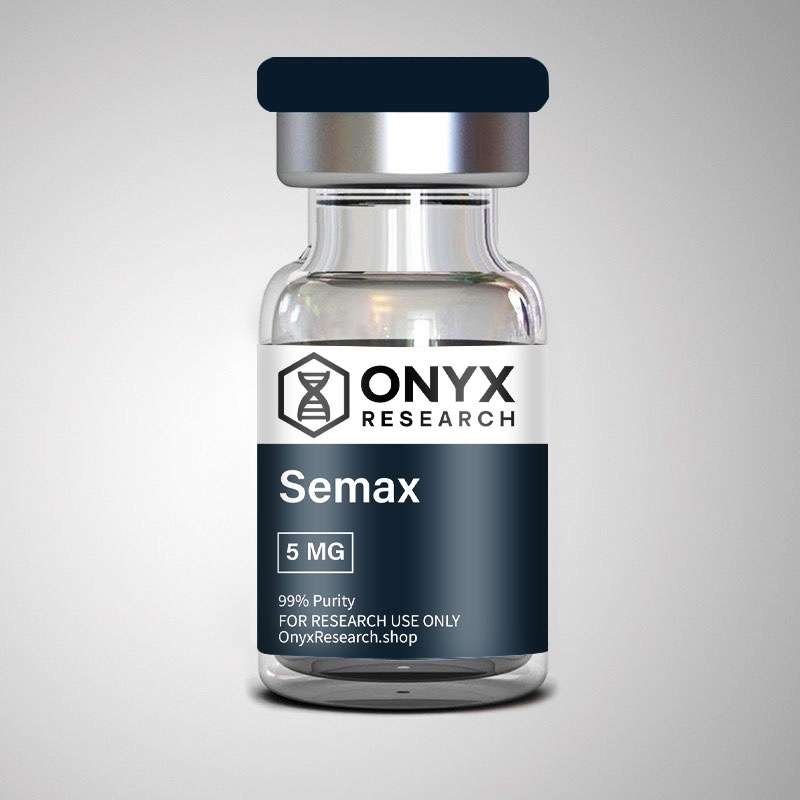
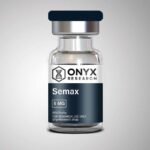
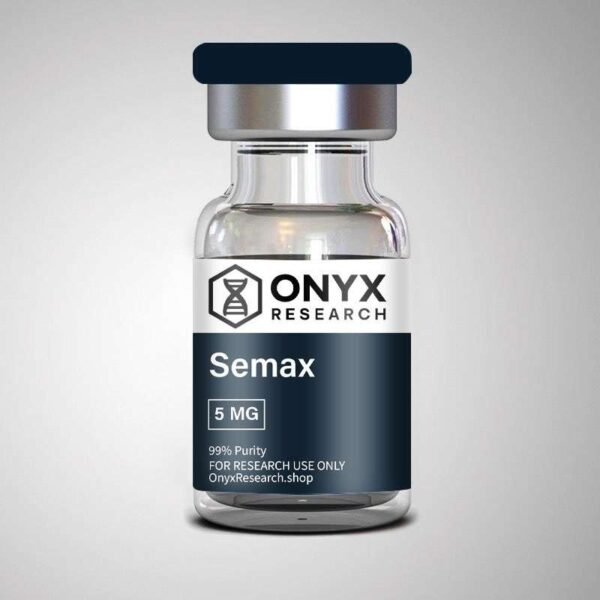
Semax
$42.00

Fast Shipping
Carrier information

20k products
Payment methods

24/7 Support
Unlimited help desk

2-day Delivery
Track or off orders
| QTY | 5mg |
|---|
Description
Semax Nasal Spray: Research, Benefits, Mechanism, and Safety
Semax nasal spray has attracted attention in peptide research because of its connection to neurobiology, cognitive
This guide explores what Semax is, how its biological activity may work, what researchers have studied, potential Semax peptide benefits, Semax and Selank comparisons, safety considerations, dosage questions, and what researchers should evaluate when considering Semax research products.
What Is Semax?
Semax is a synthetic seven-amino-acid peptide with the sequence Met-Glu-His-Phe-Pro-Gly-Pro (MEHFPGP). Researchers developed it as an analogue of the N-terminal fragment of adrenocorticotropic hormone, specifically ACTH(4–10). Unlike ACTH itself, Semax does not retain the hormone’s classical hormonal activity.
The peptide has received scientific interest because researchers have observed effects involving neuronal signaling, BDNF expression, learning, memory, and other neurological processes in experimental studies.
Semax also stands out because researchers have explored intranasal delivery. Studies in experimental animals have examined how intranasal administration affects brain concentrations and biological responses.
Semax at a Glance
| Characteristic | Semax |
|---|---|
| Peptide type | Synthetic heptapeptide |
| Sequence | Met-Glu-His-Phe-Pro-Gly-Pro |
| Related molecule | ACTH(4–10) |
| Major research area | Neuroscience |
| Research interests | BDNF, cognition, neuronal signaling, neuroprotection |
| Commonly studied route | Intranasal |
| Research status | Investigational |
| FDA-approved status in the United States | Not established as an FDA-approved Semax product |
| Key research limitation | Human evidence and long-term safety remain limited |
How Does Semax Work?
The exact mechanism of Semax remains an active area of scientific investigation.
Research has linked Semax with changes in brain-derived neurotrophic factor (BDNF) and its signaling partner TrkB. BDNF plays an important role in neuronal survival, synaptic plasticity, learning, and memory.
One animal study found that intranasal Semax increased BDNF protein levels in the rat basal forebrain. Researchers also identified specific binding sites for Semax in that brain region.
Another study reported changes in BDNF and TrkB expression in the rat hippocampus after Semax administration. These findings provide a biological basis for continued research into the peptide’s potential neurological effects.
However, researchers should distinguish between a biological mechanism observed in experimental models and a proven therapeutic effect in humans.
Semax and BDNF
BDNF supports several important processes in the nervous system.
Researchers associate BDNF with:
- Neuronal survival
- Synaptic plasticity
- Learning
- Memory formation
- Neural adaptation
- Brain development
Semax research has attracted attention because experimental studies have observed changes in BDNF-related signaling.
In one rat study, intranasal Semax increased BDNF protein in the basal forebrain. Another study found changes involving both BDNF and TrkB in the hippocampus.
These findings make BDNF an important research pathway when evaluating Semax.
Semax and Neuroprotective Research
Researchers have also explored Semax in models involving neuronal stress and neuroprotection.
The interest comes partly from the peptide’s relationship with BDNF and other neurological pathways. Some experimental studies have reported effects involving learning, memory, neuronal responses, and neuroprotective mechanisms.
However, “neuroprotective” describes a research area rather than proof that Semax prevents or treats neurological disease.
What Is Semax Used For in Research?
Researchers have investigated Semax across several areas of neuroscience and neurobiology.
Cognitive Research
Semax has received attention for its potential effects on learning and memory.
Experimental studies have reported changes in learning-related behavior following intranasal administration. Research has also connected these effects with BDNF-related pathways.
This makes Semax relevant to researchers studying:
- Learning
- Memory formation
- Attention
- Synaptic plasticity
- Neurotrophic signaling
- Cognitive performance
Neurobiology Research
Semax can serve as a research tool for examining interactions between peptide signaling and brain function.
Researchers can study how a small peptide influences molecular pathways associated with neuronal activity, BDNF, and other neurotrophic factors.
Neuroprotection Research
Experimental research has investigated Semax in models involving neuronal stress and hypoxia-related processes.
Researchers remain interested in whether its molecular effects could help explain observed neuroprotective activity in laboratory models.
The available evidence does not justify treating Semax as a proven neuroprotective therapy for people.
Brain-Derived Neurotrophic Factor Research
BDNF represents one of the most interesting pathways associated with Semax.
Researchers have observed changes in BDNF protein and gene expression following Semax exposure in experimental models.
This research helps explain why Semax continues to attract interest among neuroscience researchers.
Semax Peptide Benefits: What Does Research Suggest?
Searches for Semax peptide benefits often produce broad claims about cognition, focus, memory, brain health, and neuroprotection.
A better approach separates research observations from established clinical outcomes.
Cognitive Research
Experimental studies have reported effects on learning and memory. Some research has also associated Semax exposure with BDNF and TrkB signaling.
These findings support further investigation but do not establish Semax as a proven cognitive enhancer.
Neurotrophic Signaling
Semax has been associated with changes in BDNF-related signaling in experimental models.
That relationship provides a useful avenue for studying neuroplasticity and neuronal adaptation.
Neuroprotection
Researchers have investigated Semax in experimental models involving neuronal stress.
The findings remain an area of research rather than a basis for claiming guaranteed neuroprotection in humans.
Attention and Memory Research
Some published studies have examined Semax in relation to attention and memory. Researchers have proposed that changes in BDNF and other signaling pathways may contribute to these effects.
More research remains necessary to determine how consistently these observations translate across different populations and conditions.
Semax Nasal Spray and Intranasal Peptide Research
The interest in intranasal Semax partly comes from the challenges associated with delivering peptide molecules to the central nervous system.
The nasal route can provide a potential pathway for peptide delivery while avoiding some limitations associated with gastrointestinal degradation.
Research into intranasal peptide delivery examines factors such as:
- Peptide stability
- Nasal absorption
- Molecular size
- Formulation
- Solubility
- Nasal residence time
- Bioavailability
- Distribution to the central nervous system
A review of intranasally delivered peptides notes that nasal delivery can offer advantages for peptide administration, while formulation, bioavailability, permeability, and nasal deposition remain important challenges.
Why the Nasal Route Matters
The nasal cavity has anatomical connections with pathways associated with the central nervous system.
Researchers have therefore explored whether intranasal delivery can facilitate exposure of certain molecules to brain tissue.
Reviews of nose-to-brain delivery describe olfactory and trigeminal pathways as potential routes for CNS-targeted delivery. However, researchers still need to account for formulation, absorption, distribution, and biological variability.
Semax research fits within this larger field of intranasal peptide delivery.
Semax and BDNF Research
BDNF deserves special attention because several Semax studies have examined its expression.
In a rat study, researchers found that intranasal Semax increased BDNF protein levels in the basal forebrain. The study also identified specific Semax binding sites in that region.
Another study examined Semax in the rat hippocampus and reported changes involving BDNF and TrkB expression. Researchers proposed that these changes could contribute to the peptide’s observed effects on cognitive functions.
These findings provide a compelling research pathway:
Semax → BDNF/TrkB signaling → neuronal plasticity-related processes
Scientists still need stronger evidence to determine the clinical significance of this pathway in humans.
Semax Side Effects and Safety
Semax side effects remain an important search topic because the amount of high-quality safety information available to consumers does not match the number of online claims.
FDA’s current information identifies Semax as a heptapeptide and states that compounded drugs containing Semax may pose risks related to immunogenicity for certain routes of administration, as well as potential aggregation and peptide-related impurities.
These concerns make product quality particularly important.
Why Peptide Purity Matters
A research peptide can contain unwanted substances if manufacturing and purification processes do not adequately control impurities.
Potential concerns include:
- Incorrect peptide identity
- Peptide degradation
- Aggregation
- Residual manufacturing impurities
- Contamination
- Batch-to-batch variability
Researchers should therefore examine analytical documentation rather than relying only on product descriptions.
What Researchers Should Know About Safety
The absence of a well-established adverse-effect profile does not mean that a peptide has no risks.
Instead, it means researchers have limitations in the available safety evidence.
For an investigational peptide, researchers should consider:
- The quality of available human data
- Animal research findings
- Route of administration
- Product purity
- Peptide stability
- Potential immunogenicity
- Long-term uncertainty
Semax Dosage: What Does Research Show?
Semax dosage appears frequently in online searches, but researchers should distinguish experimental doses from established human medical instructions.
Published studies have used specific amounts under controlled experimental conditions. For example, a rat study investigating BDNF reported intranasal Semax exposure at 50 and 250 micrograms per kilogram.
Those experimental doses do not establish an appropriate human dose.
Animal studies and human studies can differ substantially in:
- Metabolism
- Absorption
- Distribution
- Peptide clearance
- Body size
- Receptor expression
- Biological response
For that reason, this page does not convert experimental doses into a self-administration protocol.
Researchers should instead consult the relevant study methodology and institutional research procedures when designing laboratory experiments.
Semax and Selank
The search Semax and Selank reflects interest in two peptides often discussed within the broader nootropic and neuroscience research space.
However, they have different structures and research histories.
Semax is a seven-amino-acid analogue related to ACTH(4–10). Selank is a different synthetic peptide derived from tuftsin-related sequences.
Their research interests also differ.
Semax
Research focuses on:
- BDNF signaling
- Learning and memory
- Neuroprotective mechanisms
- Attention
- Neuronal signaling
Selank
Research has focused more heavily on:
- Anxiolytic-related activity
- Stress responses
- Neuroimmune interactions
- Cognitive and behavioral models
These differences mean researchers should not treat the two peptides as interchangeable.
Selank vs Semax
The Selank vs Semax comparison becomes clearer when you examine their biological research targets.
| Research characteristic | Semax | Selank |
|---|---|---|
| Peptide class | Synthetic heptapeptide | Synthetic peptide |
| Major research interest | Neurobiology and cognitive pathways | Stress, anxiety-related and neuroimmune research |
| BDNF research | Yes | Different research emphasis |
| Cognitive research | Yes | Yes |
| Intranasal research | Yes | Yes |
| Research status | Investigational | Investigational |
| Clinical conclusions | Limited evidence | Limited evidence |
The two compounds may appear together in online discussions, but their mechanisms and research applications should remain distinct.
Semax vs Selank: Which Is Better?
There is no scientifically established answer to whether Semax or Selank is “better.”
The answer depends on the research question.
A researcher interested in BDNF-related neurobiology may examine Semax.
A researcher studying stress-related pathways may investigate Selank.
Comparisons should therefore focus on:
- Molecular structure
- Biological targets
- Experimental model
- Research endpoint
- Evidence quality
- Formulation
- Route of administration
A compound’s popularity online does not establish superiority.
Semax Nasal Spray and Cognitive Research
Semax has generated interest in cognitive research because experimental studies have reported effects involving learning, memory, and attention.
One PubMed-indexed paper describes research in which Semax influenced learning and attention and discusses possible connections with central BDNF synthesis.
Researchers can explore questions such as:
- Does Semax influence neuronal plasticity?
- Does it alter BDNF expression?
- How does intranasal delivery affect brain exposure?
- Which molecular pathways contribute to observed behavioral changes?
- Do experimental effects translate consistently across species?
These questions offer more scientifically useful context than simply describing Semax as a “nootropic.”
Semax and Neuroprotective Research
Neuroprotection describes biological processes that help maintain neuronal function under stressful conditions.
Researchers have studied Semax in experimental settings involving neuronal stress and hypoxia.
Some published research reports changes in neurotrophic factors and related pathways following Semax exposure.
However, experimental neuroprotection does not automatically translate into prevention or treatment of human neurological disease.
That distinction should remain clear when interpreting Semax research.
Semax for Sale: What Should Researchers Check?
Searches for Semax for sale and buy Semax often reflect commercial research intent.
Before evaluating any research peptide supplier, researchers should examine the product documentation.
1. Certificate of Analysis
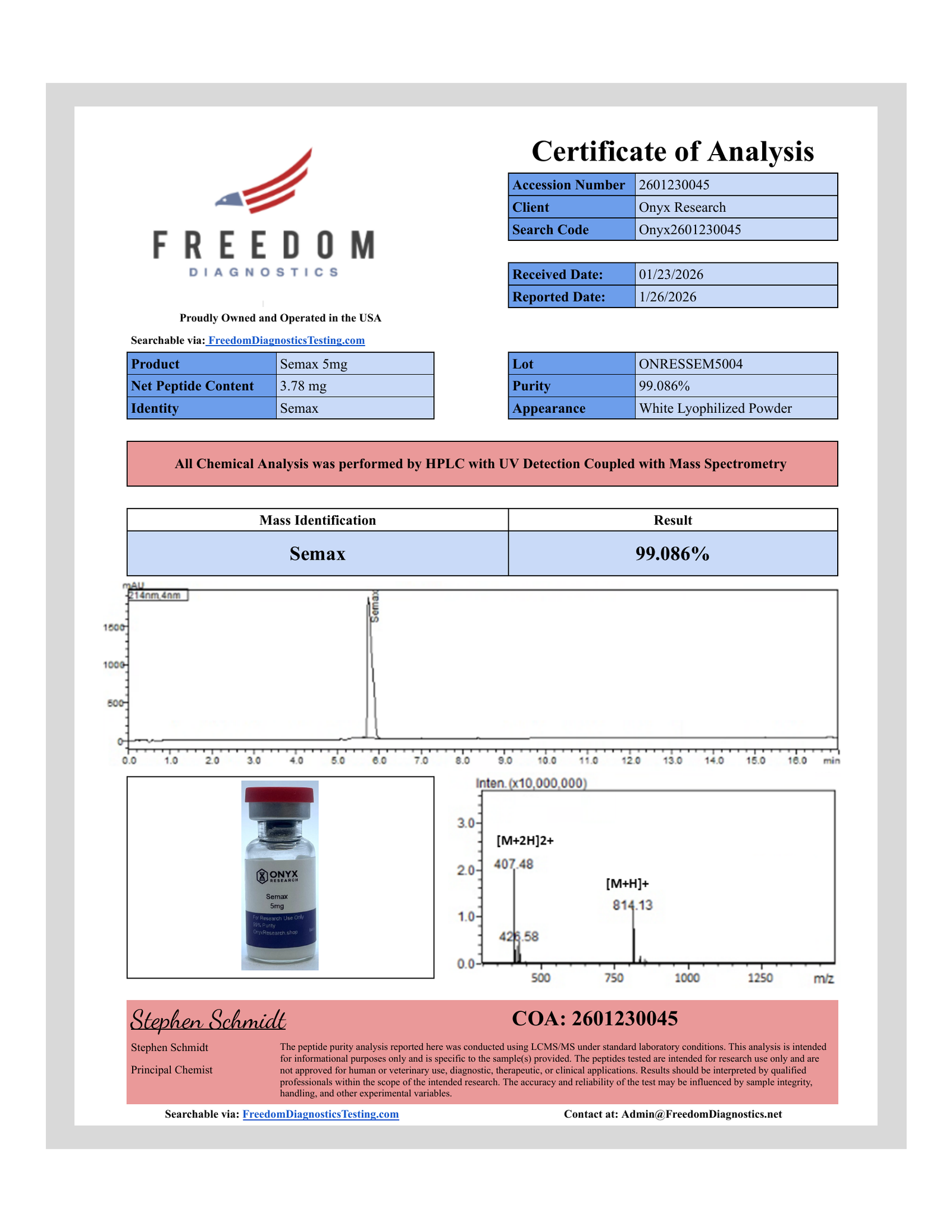
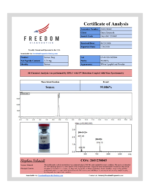
A batch-specific Certificate of Analysis can provide useful information about identity and purity.
2. Peptide Identity
The supplier should clearly identify the compound and its chemical description.
3. Purity Testing
Look for analytical evidence supporting the stated purity.
4. Batch Traceability
A batch number should connect the material to the relevant analytical documentation.
5. Storage Information
Researchers need appropriate information about storage and stability.
6. Research-Use Labeling
A legitimate research supplier should clearly distinguish laboratory materials from approved medicines.
7. Transparent Product Information
Avoid suppliers that promise guaranteed cognitive enhancement, disease treatment, or other unsupported human outcomes.
Buy Semax: Local vs Online Research Suppliers
When someone searches buy Semax, they may be looking for either a research supplier or a medical product.
Those are not the same thing.
Researchers evaluating an online supplier should focus on documentation rather than location or price alone.
Useful questions include:
- Does the supplier provide a COA?
- Does the documentation identify the batch?
- Does the supplier clearly state the peptide identity?
- Does the supplier provide storage information?
- Does the product have clear research-use labeling?
- Does the supplier avoid unsupported therapeutic claims?
These questions can help researchers distinguish a transparent supplier from a poorly documented listing.
Why Semax Product Quality Matters
Semax research depends on reliable experimental material.
If the material contains unexpected impurities or differs from the stated identity, researchers may obtain misleading results.
Important quality characteristics include:
- Identity
- Purity
- Stability
- Concentration
- Batch consistency
- Impurity profile
- Packaging
- Storage conditions
- Analytical testing
FDA’s current discussion of Semax highlights concerns involving immunogenicity, aggregation, and peptide-related impurities.
That makes analytical documentation especially important for researchers evaluating Semax products.
Who Studies Semax?
Semax can interest researchers in several scientific disciplines.
Neuroscience
Neuroscientists can investigate learning, memory, neuronal signaling, and neuroplasticity.
Molecular Biology
Molecular researchers can study BDNF, TrkB, and gene-expression pathways.
Pharmacology
Pharmacologists can investigate dose-response relationships, biological activity, and peptide interactions.
Pharmaceutical Science
Formulation scientists can study intranasal peptide delivery, stability, absorption, and bioavailability.
Neurobiology
Neurobiologists can explore how Semax affects neuronal pathways and brain-related biological processes.
Is Semax FDA Approved?
Semax should not be presented as an FDA-approved drug in the United States.
FDA currently lists Semax among substances being evaluated in the context of bulk drug substances used in compounding and identifies safety concerns associated with compounded Semax products.
Researchers and consumers should also remember that regulatory status can differ by country and by specific formulation.
When a website claims that a peptide is “FDA approved,” readers should verify the exact product and indication through official FDA resources rather than relying on advertising language. FDA explains that consumers can check approved drugs through resources such as Drugs@FDA.
Frequently Asked Questions About Semax Nasal Spray
What is Semax nasal spray?
Semax nasal spray refers to an intranasal formulation of Semax, a synthetic seven-amino-acid peptide related to ACTH(4–10). Researchers have studied Semax in connection with cognitive and neurobiological processes.
What are Semax peptide benefits?
Research has investigated Semax in areas involving learning, memory, attention, BDNF signaling, and neuroprotective mechanisms. However, these research findings do not establish proven therapeutic benefits for every claimed use.
How does Semax work?
Research suggests that Semax can influence neurotrophic pathways, including BDNF and TrkB signaling. Animal studies have observed changes in BDNF protein and gene expression following Semax exposure.
What is Semax used for?
Researchers study Semax in neuroscience, cognitive research, neuroprotection, neuronal signaling, and intranasal peptide delivery.
What are Semax side effects?
The complete human safety profile remains uncertain. FDA has raised concerns about potential immunogenicity, aggregation, and peptide-related impurities in certain compounded Semax products.
What is Semax dosage?
Published studies have used different experimental doses, particularly in animal models. Those research doses should not be treated as validated human dosing instructions.
Is Semax available as a nasal spray?
Semax has been studied through intranasal administration, and published research has examined its effects following this route.
What is the difference between Semax and Selank?
Semax and Selank are different synthetic peptides with different molecular structures and research interests. Semax research has focused strongly on neurotrophic and cognitive pathways, while Selank research has emphasized stress-related, anxiolytic, and neuroimmune pathways.
What is Selank vs Semax?
Selank vs Semax is primarily a comparison of two different investigational peptides. Researchers should compare their molecular structures, biological targets, evidence base, and experimental applications rather than assuming one peptide is universally better.
Can Semax increase BDNF?
Experimental studies have reported increases in BDNF-related measures following Semax exposure in animal models. One study observed increased BDNF protein in the rat basal forebrain, while another reported changes in BDNF and TrkB expression in the rat hippocampus.
Is Semax a nootropic?
Semax is often described online as a nootropic because research has investigated learning, memory, and attention. However, “nootropic” is not an FDA-approved indication, and research findings should not be confused with established clinical efficacy.
Where can researchers buy Semax?
Researchers evaluating Semax for sale should focus on suppliers that provide clear compound identification, batch information, purity documentation, Certificates of Analysis, storage information, and research-use labeling.
What should researchers check before they buy Semax?
Researchers should examine peptide identity, purity, analytical testing, batch traceability, storage requirements, and supplier transparency. Price alone does not establish research quality.
Is Semax safe for human use?
The available evidence does not establish a complete long-term human safety profile. Researchers should carefully distinguish published experimental evidence from unsupported online safety claims.
Final Takeaway
Semax nasal spray remains an interesting subject within peptide and neuroscience research because scientists have investigated its effects on learning, memory, BDNF signaling, neuronal pathways, and neuroprotective mechanisms.
Semax is a synthetic heptapeptide related to the ACTH(4–10) fragment. Research has identified potential relationships between Semax and BDNF/TrkB signaling, providing one possible explanation for its observed effects in experimental models.
Intranasal delivery also gives Semax a distinctive research profile. Scientists continue to investigate how nasal peptide formulations affect absorption, bioavailability, and potential CNS exposure.
At the same time, researchers should avoid turning experimental findings into guaranteed human benefits. Semax remains an investigational compound in the U.S. regulatory context, and FDA has raised concerns involving immunogenicity, aggregation, and peptide-related impurities associated with certain compounded Semax products.
For laboratory research, product quality matters. Researchers should prioritize compound identity, analytical testing, purity documentation, batch traceability, storage information, and transparent research-use labeling.
Research-use notice: This page provides educational information about Semax research. It does not provide a personal treatment plan, human dosing protocol, or medical recommendation. Researchers should follow applicable institutional, regulatory, and laboratory requirements.


Reviews
Clear filtersThere are no reviews yet.